
Cylinder refill vs. exchange: which saves you more in Florida
By Mei Larsen · Updated 2026-07-06
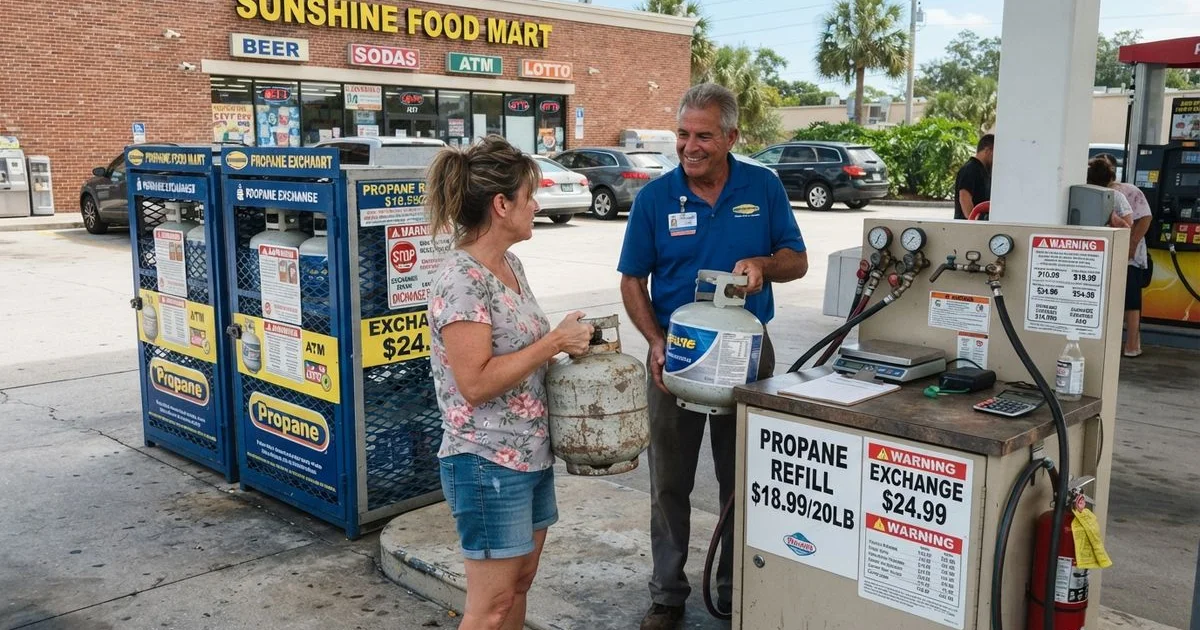
If you have ever stood in a hardware store parking lot comparing a refill hose to an exchange cage, the price tags rarely tell the whole story. Both get you a working tank. They do not get you the same amount of propane for the same money, and in Florida, where grills, patio heaters, and RV trips run almost year-round, that difference adds up.
Refilling means a propane supplier connects your existing cylinder to a bulk tank and fills it by weight, charging per gallon or per pound. You keep your own tank the whole time. Exchange means you hand over your empty cylinder and get a different, pre-filled one from a cage, usually parked outside a gas station, hardware store, or grocery store.
The direct cost comparison
| Refill | Exchange | |
|---|---|---|
| How it’s priced | Per pound or per gallon of propane put in | Flat fee per swap |
| Typical fill level | Filled to the 80% capacity limit (about 20 lb on a standard tank) | Often 15 to 17 lb, even though the fee is close to a full-tank price |
| Speed | A few minutes if the station is staffed and not busy | Usually fastest, grab-and-go from a cage |
| Tank condition | You keep your own tank; must pass a visual check | You get a random tank from the cage; condition varies |
| Best for | Regular grill use, RVs, and anyone who tracks value per pound | One-off trips, late-night or off-hours needs, convenience stops |
The pattern holds across most of Florida’s propane suppliers: refilling tends to land at a lower cost per pound of actual propane, while exchange trades some of that value for speed and availability. If your regular hardware store has a fill station instead of just a cage, that is often the better default for routine use.
What actually drives the price gap
A few things push refill and exchange costs apart beyond the simple per-pound math:
- Fill accuracy. A refill station weighs your tank empty, then fills it to the 80% safety limit and weighs it again, so you pay for what you got. Exchange cages standardize the fill level across every tank in the rotation, which is faster for the retailer but rarely nets you a truly full 20 lb.
- Tank ownership. With refill, the tank is yours the entire time, so there is no deposit or swap fee baked in. With exchange, part of what you are paying for is convenience: you do not have to wait around, and you are not stuck driving home with an empty tank if the cage is out of stock.
- Certification status. Cylinders need a stamped date and, past 12 years, a recertification. A station that finds an expired or visibly damaged tank at refill time will often refuse it outright, pushing you toward exchange whether or not it is the cheaper option that day.
- Volume and season. Prices swing with wholesale propane costs and seasonal demand. Summer cookout months and any pre-storm rush can push both refill and exchange prices up at the same time.
Which one actually makes sense for you
If you use a tank regularly, whether for a home grill, a pool heater backup, or a small business, refilling at a dedicated station usually wins on cost over a year of use, and you get to know the tank you are working with. If you need a fast swap on your way to a cookout and do not want to wait, or your own tank just failed inspection, exchange is the practical fallback even at a slightly worse per-pound rate.
Some households do both: refill when they have time to visit a station, and keep a spare exchange tank in the truck for the times they run out unexpectedly. If reliability matters more than shaving a few dollars, like keeping a backup cylinder for a generator during hurricane season, having both options on your radar is worth more than optimizing for the lowest price every single time. Either way, how you store and handle the cylinder between fills matters as much as what you paid for it.
Before choosing a provider, it helps to browse cylinder refill and exchange suppliers near you and check which ones actually fill by weight rather than just topping off. Our scoring method weighs pricing transparency and fill accuracy alongside review history, so the suppliers ranked higher tend to be the ones customers trust to give a fair fill.
Questions people ask
- Is refilling always cheaper than exchanging a propane tank?
- Usually, yes, per gallon. Refilling charges you for the actual propane put back into your tank, while exchange cages charge a flat swap fee that assumes a partial fill. The gap narrows if your old tank is dented, rusty, or past its recertification date, since a refill station may turn it away and you end up exchanging anyway.
- Why do exchange tanks feel lighter than a full 20 lb tank?
- Exchange cages commonly fill to around 15 to 17 lb rather than a full 20, partly for safety margin and partly because it is faster to swap a standard fill level across thousands of tanks than to weigh each one individually. You are paying close to a full-tank price for a partial fill.
- Can I bring any tank to a refill station?
- Only if it has a current certification date stamped on the collar and an OPD valve (the triangular handle required on tanks made after 1998). Expired or damaged cylinders get refused, which is the main reason people end up exchanging instead of refilling even when refilling is cheaper.
- Does it cost more to refill a 30 lb or 40 lb cylinder than a 20 lb one?
- It costs more in total dollars since you are buying more propane, but the per-gallon rate is usually the same or slightly better on larger cylinders. RV and forklift owners with 30 to 40 lb tanks tend to save more per pound by refilling than exchanging, since exchange programs are built around the standard 20 lb grill size.