
Propane service for manufactured and mobile homes in Florida
By Mei Larsen · Updated 2026-07-31
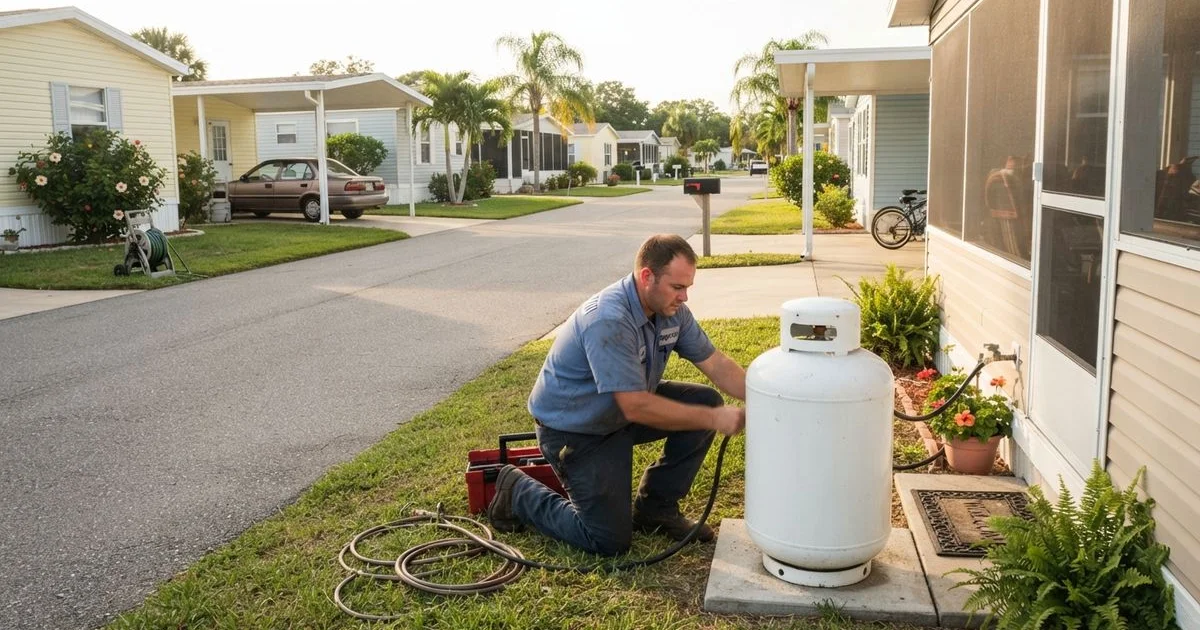
Propane works a little differently in manufactured home communities and standalone mobile homes than it does in a typical site-built house, mostly around who owns the tank and how service gets arranged. Here is what to know before you move in or set up service.
Individual tank vs. shared community infrastructure
Manufactured home communities in Florida handle propane a few different ways. Some parks maintain shared bulk tank infrastructure and bill residents through the park itself, similar to how water or sewer might be handled. Others allow or require each resident to have an individually owned or leased tank with a direct account through a propane supplier of their choice.
Neither approach is inherently better, but they matter a lot for your day-to-day experience: a shared system means less to manage yourself but less choice in supplier, while an individual tank means more responsibility but more control over pricing and service quality. If cost is the bigger concern, our guide to free and low-cost propane help in Florida covers assistance programs many manufactured home households qualify for.
What to ask before moving in
| Question | Why it matters |
|---|---|
| Is propane individually metered or included in lot rent? | Affects your monthly budget and billing |
| Who owns the tank, the park or the resident? | Determines who you contact for maintenance or a leak |
| Can residents choose their own supplier? | Affects your ability to shop for better pricing |
| Who handles emergency response for a leak? | Clarifies whether it’s the park, a specific supplier, or you |
| Is the tank and line up to current code? | Older communities may have systems that predate current standards |
Tank sizing for manufactured homes
Smaller lots and more compact home footprints mean manufactured homes often work well with smaller ASME tanks, commonly in the 120 to 250 gallon range, rather than the larger tanks used for bigger site-built homes. The right size still depends on how much propane your home uses: heating, hot water, cooking, or some combination. A tank size calculator that accounts for your home’s size and how you use propane gives a reasonable starting range before you contact suppliers.
Installation and safety considerations
Manufactured and mobile homes often have different underbelly, skirting, and clearance configurations than site-built houses, which affects how gas lines get routed and how ventilation around connection points works. A qualified installer with specific experience in manufactured housing setups is worth seeking out rather than assuming any residential installer’s general experience covers it equally well.
If you are buying a used manufactured home or moving into an existing unit, it is worth having the propane system inspected specifically, the same way you would for a site-built home, rather than assuming a smaller system needs less scrutiny. Tank condition, line integrity, and cylinder recertification status (if portable cylinders are used instead of a fixed tank) all matter regardless of home type. Ask the previous owner or park management for any maintenance or inspection history they have on file, since manufactured homes change hands more frequently than site-built houses and records can get lost between owners.
Renting a lot vs. owning your manufactured home
Whether you own your manufactured home outright or rent a lot in a community changes some of the practical steps. Homeowners who own their lot typically have the most flexibility to set up an individual tank and choose a supplier freely. Residents renting a lot within a community are more likely to be tied to whatever arrangement the park has in place, so it is worth asking about this specifically during the lease signing process, not after you have already moved in and discovered the propane setup is not what you expected.
If you are relocating a manufactured home to a new lot, confirm with your installer and the park management that the intended tank placement meets both Florida Fire Code setback requirements and any additional rules the community itself may have about tank visibility or placement near shared spaces.
Setting up or switching service
If you have the option to choose your own supplier, compare pricing, delivery reliability, and whether they have specific experience with manufactured home installations, since that experience can help confirm your tank size and placement meet the specific requirements of your lot. Our directory lists Florida suppliers, and our scoring method explains how we weigh service quality when ranking them.
Questions people ask
- Do manufactured homes use different propane tanks than site-built houses?
- Not fundamentally, but the sizing and setup often differ. Many manufactured homes use smaller ASME tanks (commonly 120 to 250 gallons) given more compact lots, and in a manufactured home community, the tank may be shared infrastructure or individually assigned depending on the park's setup.
- Who owns the propane tank in a manufactured home community?
- It varies by community. Some parks own and maintain community tank infrastructure and bill residents through a metered or flat arrangement, while others allow or require residents to have their own tank with an individual supplier account. Ask the park management directly since this affects who you contact for service and any leak concerns.
- Can I choose my own propane supplier in a manufactured home park?
- It depends on the park's arrangement. If the park has an exclusive contract with one supplier for community infrastructure, you may not have a choice. If residents manage individual accounts and own tanks, you typically can shop around like any other homeowner.
- Is propane safety different for a mobile home compared to a site-built house?
- The core safety principles are the same, but mobile and manufactured homes often have tighter clearances and different underbelly or skirting configurations, which can affect gas line routing and ventilation. A qualified installer familiar with manufactured housing setups should handle installation and repairs.