
What to expect when setting up commercial propane service in Florida
By Mei Larsen · Updated 2026-08-02
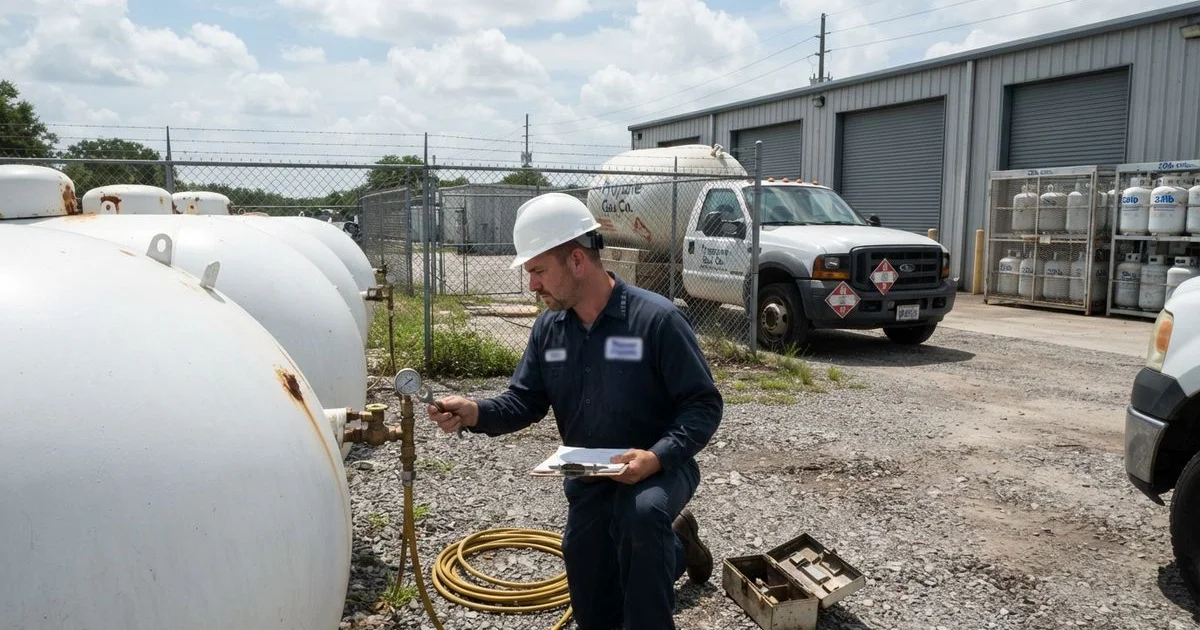
Setting up commercial propane service involves more moving parts than a residential account, mostly because the stakes are higher: a stalled forklift fleet or a halted production line costs real money in a way a delayed home delivery does not. Here is what the process typically looks like.
The setup process, step by step
- Initial consultation. A supplier representative discusses your business’s propane needs: what equipment you’re fueling, expected volume, and any special requirements like autogas for a vehicle fleet or process heat for manufacturing.
- Site assessment. For bulk tank installations, a technician evaluates your property for tank placement, access for delivery trucks, and code compliance, similar to a residential site visit but scaled for larger equipment and volume.
- Contract negotiation. This covers pricing structure (fixed, capped, or market-indexed), minimum usage commitments, tank ownership, delivery frequency, and terms for emergency service.
- Permitting. Commercial installations generally require permitting through your local building or fire department, and larger tanks or more complex setups can mean more scrutiny than a standard residential install.
- Installation. For a new bulk tank, this follows a similar sequence to residential installation: site prep, tank placement, connection, pressure testing, and inspection, just at a larger scale.
- Account activation and first delivery. Once everything passes inspection, your account is activated and scheduled for regular delivery based on your agreed terms.
What a typical timeline looks like
| Stage | Rough timeframe |
|---|---|
| Initial consultation and quote | Within a week or two of first contact |
| Site assessment (if a new tank is needed) | One to two weeks to schedule and complete |
| Permitting | Several weeks, depending on scope and county |
| Installation | A few days for a straightforward bulk tank setup |
| Account activation | Once inspection passes and paperwork is finalized |
Businesses that only need cylinder exchange or a standard delivery account with existing infrastructure move much faster than those installing a new bulk tank from scratch.
What to negotiate before signing
Commercial propane contracts run on different terms than home delivery, so it pays to look past the initial quote. Ask whether pricing is fixed, capped, or tied to a market index, and get the delivery radius and any minimum gallon commitments in writing. Confirm the supplier carries equipment suited to your specific use, whether that is forklift cylinder exchange, bulk storage for process heat, or autogas fueling, rather than a general residential setup adapted for business use.
Response time for emergency refills matters more here than in home service. Ask about after-hours contacts, backup delivery trucks, and whether the company services its own tanks or subcontracts that work out, since a subcontracted response can mean slower turnaround during a real emergency.
Choosing between a supplier-owned and business-owned tank
A supplier-owned tank as part of your service contract shifts maintenance responsibility to the supplier, which can simplify things for a business that would rather not manage equipment upkeep directly. A business-owned tank gives more independence, including the freedom to shop between suppliers for propane pricing, but puts maintenance and inspection responsibility on your business. Which makes sense depends on how much operational bandwidth you have for managing the equipment side versus just the fuel supply.
Planning around seasonal and storm-related demand
Florida businesses that rely on propane for backup generators should factor hurricane season into their contract discussions from the start. Ask potential suppliers directly how they prioritize commercial accounts during high-demand periods after a storm, and whether your contract includes any guaranteed response time for emergency refills during those windows. A business running on generator power during an extended outage cannot afford the same wait a residential customer might tolerate, so this is worth confirming in writing rather than assuming standard service applies.
Switching commercial suppliers later
If you already have commercial propane service and are considering a switch, review your current contract for minimum commitment periods, tank removal terms if the tank is supplier-owned, and any early termination costs before starting the process with a new provider. Overlapping the transition, keeping your current service active until the new account and any new equipment are fully operational, avoids a gap that could affect your operations.
Finding the right commercial supplier
When comparing commercial and industrial propane suppliers in Florida, ask specifically about their experience with your type of equipment, their emergency response process, and how transparent they are about contract terms before you sign anything. Our directory covers suppliers across the state, and our scoring method weighs reliability and licensing as part of how we rank commercial providers.
Questions people ask
- How is commercial propane service different from residential?
- Commercial accounts typically involve larger volume commitments, different contract terms, and equipment sized for business use, like forklift cylinder exchange stations, process heat for manufacturing, or standby generator fuel. Response time expectations are also usually higher, since downtime can cost a business money in a way a delayed home delivery does not.
- How long does it take to set up a new commercial propane account?
- A straightforward account with an existing tank or standard cylinder exchange can be set up within a week or two. A new bulk tank installation for a facility involves site assessment, permitting, and installation, which can take several weeks depending on the scope and your county's permitting timeline.
- Do commercial propane contracts require a minimum usage commitment?
- Often, yes, though terms vary by supplier and account size. Ask specifically about minimum annual gallon commitments, what happens if you use less than committed, and any penalties for early contract termination before signing.
- Who owns the tank in a commercial propane setup?
- It depends on the agreement. Many commercial accounts use a supplier-owned tank as part of the service contract, which shifts maintenance responsibility to the supplier, while others involve a business-owned tank with more independence but more direct maintenance responsibility.